Fraction Calculator
Enter the values in the numerator and denominator, choose the desired operation, and click the “Calculate” button to see the step-by-step solution.
Welcome to Quick Fraction Calculator!
My name is Danish Ali, and I have completed my Bachelor’s degree in Mathematics. If you would like to know more about me, you can visit my “About Us” page.
On this website, my goal is to help you understand fractions in the simplest way possible. We’ll learn through easy explanations, step-by-step solutions, practical examples, and plenty of practice questions.
In addition to fractions, you’ll also find helpful guides on decimals, percentages, ratios, Least Common Multiple (LCM), Greatest Common Factor (GCF), and many other mathematics topics.
Before we start solving fractions, let’s first understand what a fraction is.
What is Fraction in Mathematics?
Imagine a pastry is cut into five equal pieces. If you take one piece, you have taken one of the five equal parts of the whole pastry.
In mathematics, this is written as 1/5.
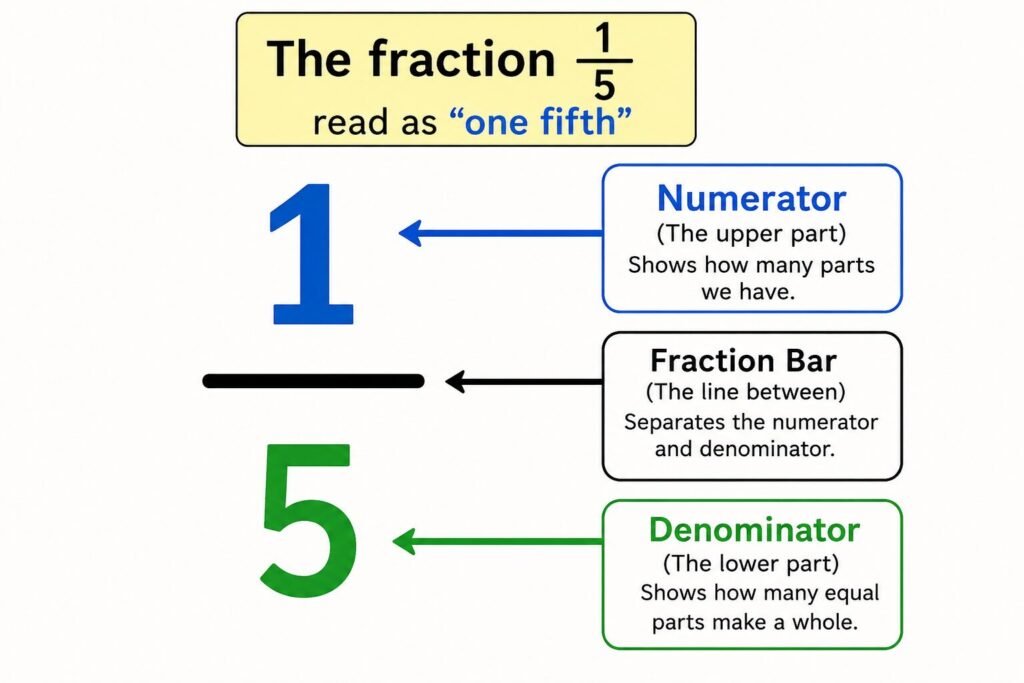
Here, the denominator 5 tells us that the pastry has been divided into five equal parts, while the numerator 1 tells us that you have taken one of those five parts.
From this example, we can define a fraction as a number that represents one or more equal parts of a whole. Fractions are written in the form a/b, where a is the numerator and b is the denominator, such as 1/5, 3/8, or 7/10.
The horizontal line between the numerator and denominator is called the fraction bar, which simply means “divided by.”
The illustration below will help you identify the three main parts of a fraction: the numerator, the denominator, and the fraction bar.
Types of Fractions
Before we start solving fraction problems, it’s important to understand the different types of fractions. Once you can recognize each type, it becomes much easier to know which rule to apply when you’re solving a problem.
Let’s go through each type one by one, with a simple example for each.
Proper Fraction
A proper fraction is a fraction in which the numerator is smaller than the denominator.
For example, 2/7 is a proper fraction because the numerator 2 is smaller than the denominator 7.
The value of a proper fraction is always less than 1. This makes sense if you think back to our pastry example: if the whole is divided into 7 parts and you only take 2 of them, you clearly have less than the whole pastry.
Improper Fraction
An improper fraction is a fraction in which the numerator is greater than or equal to the denominator.
For example, 7/4 is an improper fraction because the numerator 7 is greater than the denominator 4.
The value of an improper fraction is always equal to or greater than 1.
Mixed Fraction
A mixed fraction is made up of a whole number and a proper fraction written together.
For example, 1 3/4 is a mixed fraction. It means one whole plus three-quarters of another whole.
Mixed fractions are simply another way of writing improper fractions. For example, the improper fraction 7/4 is the same as the mixed fraction 1 3/4. Both represent the exact same amount; they are just written in different ways.
Like Fractions
Like fractions are fractions that have the same denominator.
For example, 2/9 and 5/9 are like fractions because both have the same denominator, 9.
Like fractions are the easiest to add and subtract, because when the denominators are already the same, you only need to work with the numerators.
Unlike Fractions
Unlike fractions are fractions that have different denominators.
For example, 2/3 and 4/5 are unlike fractions because their denominators, 3 and 5, are not the same.
To add or subtract unlike fractions, we first have to make the denominators the same by finding a common denominator. Don’t worry if this sounds difficult right now, we’ll explain exactly how to do it in the addition and subtraction sections.
Equivalent Fractions
Equivalent fractions are fractions that look different but represent the same value.
For example, 1/2, 2/4, and 4/8 are all equivalent fractions. Even though the numbers are different, they all represent the same amount, exactly half of a whole.
We create equivalent fractions by multiplying or dividing both the numerator and denominator by the same number. For example, if we multiply both the numerator and denominator of 1/2 by 2, we get 2/4, which has the same value.
Unit Fraction
A unit fraction is a fraction that has 1 as its numerator.
For example, 1/5 is a unit fraction because its numerator is 1.
Unit fractions represent a single equal part of a whole, just like the single slice of pastry in our earlier example.
Common Operations You Can Perform on Fractions
Once you understand the different types of fractions, the next step is learning how to perform mathematical operations with them.
You can perform the following operations on fractions:
- Adding fractions
- Subtracting fractions
- Multiplying fractions
- Dividing fractions
- Simplifying fractions
- Finding equivalent fractions
- Scaling fractions by multiplying or dividing both the numerator and denominator by the same number
You may have noticed “scaling” in the list above. Scaling simply means making a fraction larger or smaller in its written form without changing its actual value. We do this by multiplying or dividing both the numerator and denominator by the same number.
This is exactly how equivalent fractions are created, and it becomes very useful when we need to find a common denominator for addition and subtraction.
Where to Start Learning Fractions
If you now understand what a fraction is and can identify the different types of fractions, you’ve already built a strong foundation. The next step is learning how to solve fraction problems.
From my experience studying mathematics, I recommend learning fraction operations in the following order:
- Multiplying fractions
- Dividing fractions
- Adding fractions
- Subtracting fractions
I recommend starting with multiplication because it is usually the easiest operation to understand. Once you’re comfortable with multiplication, division becomes much simpler because it mainly involves finding the reciprocal and multiplying.
After that, move on to addition and subtraction. These operations often require finding a common denominator, which can seem challenging at first. However, once you understand how to find the least common denominator (LCD), both addition and subtraction become much easier.
Following this learning order will help you build confidence and make each new topic easier to understand.
How to Use Our Fraction Calculator
Adding, subtracting, multiplying, or dividing fractions takes just a few seconds. Here’s how:
- Enter your first fraction. Type the top number (numerator) in the upper box and the bottom number (denominator) in the lower box. For example, for two-sevenths you’d enter 2 on top and 7 on the bottom.
- Choose an operation. Use the dropdown in the middle to pick what you want to do: add (+), subtract (−), multiply (×), or divide (÷).
- Enter your second fraction. Fill in the numerator and denominator of the second fraction the same way.
- Click Calculate. The answer appears instantly on the right side of the equals sign, along with a full step-by-step breakdown showing exactly how the result was reached.
- Start over anytime. Hit Clear to reset all the boxes and enter new numbers.
Explore full detailed article on ” Mixed Fraction Calculator “
Faq About Fraction Calculator
What is a fraction?
A fraction is a number that represents one or more equal parts of a whole. It is written in the form a/b, where the top number is called the numerator and the bottom number is called the denominator.
How do I use the fraction calculator?
Enter the numerator and denominator of both fractions, choose the operation you want to perform, and click the Calculate button.
The calculator will instantly display the answer along with the solving steps.
What happens if the denominators are different?
When adding or subtracting fractions with different denominators, the calculator first finds the least common denominator (LCD). It then converts the fractions into equivalent fractions before performing the operation.